

锦书在线
80.52M · 2026-03-21

Cursor 提供了多种工作模式,其中 Debug 模式 专为解决那些难以复现或难以理解的 Bug 而设计。与传统调试不同,它不会立即尝试修复代码,而是先生成假设、添加日志、收集运行时数据,最后才进行精准修复。
根据 Cursor 官方文档 和 官方博客:
相比 Agent、Plan 模式,Debug 模式用的次数确实太少了。这次终于找了一个练手文件试试,防止它在大项目里面乱来。
使用 Embedding 向量进行情感分析,一段明显的好评文本被错误判断为差评。这里使用的是阿里云通义千问的 text-embedding-v4 模型:
EMBEDDING_MODEL = "text-embedding-v4"

# 参考向量
positive_review = get_embedding("好评")
negative_review = get_embedding("差评")

# 待分析文本(明显的好评)
text_to_analyze = "买的银色版真的很好看,一天就到了,晚上就开始拿起来完系统很丝滑流畅,做工扎实,手感细腻,很精致哦苹果一如既往的好品质"

# 计算相似度并判断
score = cosine_similarity(text_embedding, positive_review) -
        cosine_similarity(text_embedding, negative_review)
# 结果:score < 0 → 错误判断为差评
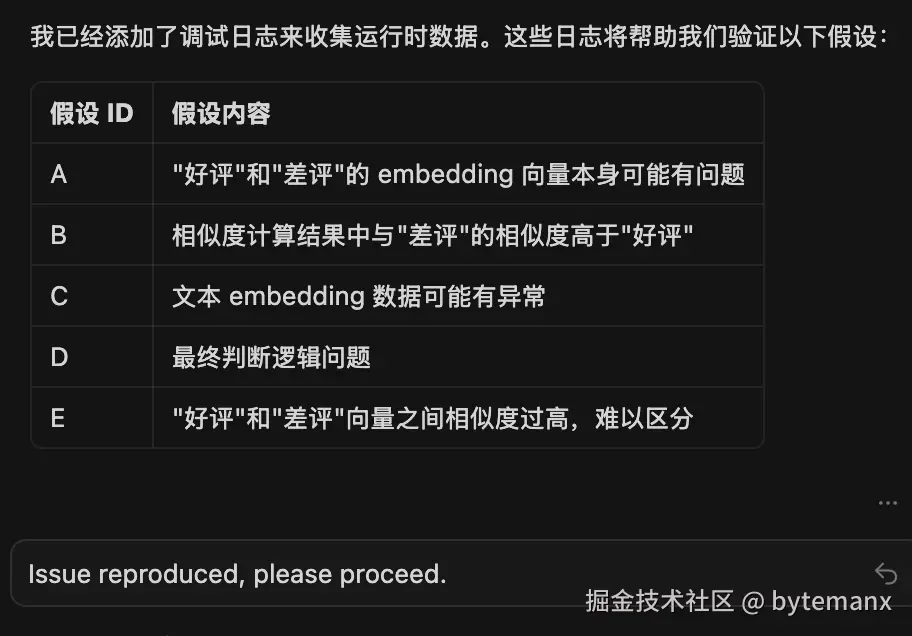
进入 Debug 模式后,AI 生成了 5 个假设:
| 假设 | 内容 |
|---|---|
| A | 参考向量本身有问题 |
| B | 相似度计算结果异常 |
| C | 文本 embedding 数据异常 |
| D | 判断逻辑有误 |
| E | "好评"与"差评"向量相似度过高 |
AI 自动插入日志后,让我们介入重新运行程序,保证 human-in-the-loop:
收集到的关键日志数据:
{"hypothesisId": "E", "message": "好评与差评向量的相似度", "data": {"pos_neg_similarity": 0.6828}}
{"hypothesisId": "B", "message": "相似度计算结果", "data": {"pos_sim": 0.4622, "neg_sim": 0.4642, "score": -0.002}}
日志揭示了问题:
使用更具语义区分度的参考句子:
# 修复前
positive_review = get_embedding("好评")
negative_review = get_embedding("差评")

# 修复后
positive_review = get_embedding("这个产品非常好,质量很棒,很满意,强烈推荐购买")
negative_review = get_embedding("这个产品非常差,质量很烂,很失望,不推荐购买")
| 指标 | 修复前 | 修复后 |
|---|---|---|
| 与正面参考相似度 | 0.4622 | 0.5615 |
| 与负面参考相似度 | 0.4642 | 0.5563 |
| score | -0.002 | +0.005 |
| 结果 | 差评 | 好评 |
Debug 结束后,我突然想到:修复后的 score 只有 +0.005,效果似乎并不理想。于是我测试了不同版本的 embedding 模型,使用原始的简单参考词("好评"/"差评"):
| 模型版本 | 与"好评"相似度 | 与"差评"相似度 | score | 结果 |
|---|---|---|---|---|
| v1 | 0.3578 | 0.3375 | +0.0203 | 好评 |
| v2 | 0.1787 | -0.0325 | +0.2113 | 好评 |
| v3 | 0.6925 | 0.5481 | +0.1444 | 好评 |
| v4 | 0.4622 | 0.4642 | -0.0020 | 差评 |
令人意外的是,v4 是唯一判断错误的版本!
根据 阿里云官方文档,v4 在 MTEB/CMTEB 评测中分数最高:
| 模型 | MTEB | CMTEB |
|---|---|---|
| text-embedding-v1 | 58.30 | 59.84 |
| text-embedding-v2 | 60.13 | 62.17 |
| text-embedding-v3(1024 维度) | 63.39 | 68.92 |
| text-embedding-v4(2048 维度) | 71.58 | 71.99 |
即使将 v4 的维度提升至 2048,结果依然是差评:
与'好评'的相似度: 0.444916
与'差评'的相似度: 0.446109
综合分数: -0.001192
结果: 差评
在这个简单情感分类任务上,模型表现排序:v2 > v3 > v1 > v4
这说明:评测基准分数高 ≠ 所有任务都表现好。选择模型时需要在实际场景中测试。