


荣耀基础服务App
80.64MB · 2026-04-16

前置文章【LLM说: 给我Tools,我来安排工作流(Agentic workflows)】
在全栈开发中,我们经常需要调用接口,或者说微服务中我们通过RPC的方式调用远程服务,而在Agent应用开发中,我们将接口封装为工具(Tools)暴露出来给LLM使用
把工具(Tools)看作代理的执行器(actuators):你给出一条自然语言指令(例如“查看老板发来的未读邮件并礼貌回复”),模型就会选择调用哪些工具以及按什么顺序来完成任务。
Agentic workflow可以执行与邮件管理相关的各种任务,包括发送邮件、搜索特定发件人的邮件以及删除邮件。使用用自然语言指令来操作——例如“查看老板发来的未读邮件”或“删除那封‘欢乐时光’邮件”——它选择合适的工具并完成任务。
使用一个模拟的邮件后端来模拟真实的邮件交互。你可以把它当作一个个人沙箱邮件收件箱:其中已预先加载了一些邮件,方便你在不发送真实邮件的情况下进行模拟。
【deeplearning.ai的提供的后端代码】
| Layer | Purpose |
|---|---|
| FastAPI | Exposes REST endpoints |
| SQLite + SQLAlchemy | Stores and queries emails locally |
| Pydantic | Ensures inputs and outputs are valid |
| AISuite tools | Bridge between the LLM and the service |
该服务提供了若干路由,用于模拟常见的邮件操作。稍后,这些路由将被封装成工具,以便助手能够自动使用它们
| Endpoint | Description |
|---|---|
POST /send | Send a new email |
GET /emails | List all emails |
GET /emails/unread | Show only unread emails |
GET /emails/{id} | Fetch a specific email by ID |
GET /emails/search?q=... | Search emails by keyword |
GET /emails/filter | Filter by recipient or date range |
PATCH /emails/{id}/read | Mark an email as read |
PATCH /emails/{id}/unread | Mark an email as unread |
DELETE /emails/{id} | Delete an email by ID |
GET /reset_database | Reset emails to initial state (for testing) |
在全栈开发中,我们经常需要调用接口,或者说微服务中我们通过RPC的方式调用远程服务,而在Agent应用开发中,我们将接口封装为工具(Tools)暴露出来给LLM使用
把工具(Tools)看作代理的执行器(actuators):你给出一条自然语言指令(例如“查看老板发来的未读邮件并礼貌回复”),模型就会选择调用哪些工具以及按什么顺序来完成任务。
def list_all_emails() -> list:
    """
    Fetch all emails stored in the system, ordered from newest to oldest.

    Returns:
        List[dict]: A list of all emails including read and unread,
        each represented as a dictionary with keys:
        - id
        - sender
        - recipient
        - subject
        - body
        - timestamp
        - read (boolean)
    """
    return requests.get(f"{BASE_URL}/emails").json()
| Tool Function | Action |
|---|---|
list_all_emails() | Fetch all emails, newest first |
list_unread_emails() | Retrieve only unread emails |
search_emails(query) | Search by keyword in subject, body, or sender |
filter_emails(...) | Filter by recipient and/or date range |
get_email(email_id) | Fetch a specific email by ID |
mark_email_as_read(id) | Mark an email as read |
mark_email_as_unread(id) | Mark an email as unread |
send_email(...) | Send a new (simulated) email |
delete_email(id) | Delete an email by ID |
search_unread_from_sender(addr) | Return unread emails from a given sender (e.g., boss@email.com) |
提示词
def build_prompt(request_: str) -> str:
    return f"""
- You are an AI assistant specialized in managing emails.
- You can perform various actions such as listing, searching, filtering, and manipulating emails.
- Use the provided tools to interact with the email system.
- Never ask the user for confirmation before performing an action.
- If needed, my email address is "you@email.com" so you can use it to send emails or perform actions related to my account.

{request_.strip()}
"""
example_prompt = build_prompt("Delete the Happy Hour email")

"""
- You are an AI assistant specialized in managing emails.
- You can perform various actions such as listing, searching, filtering, and manipulating emails.
- Use the provided tools to interact with the email system.
- Never ask the user for confirmation before performing an action.
- If needed, my email address is "you@email.com" so you can use it to send emails or perform actions related to my account.

Delete the Happy Hour email
"""
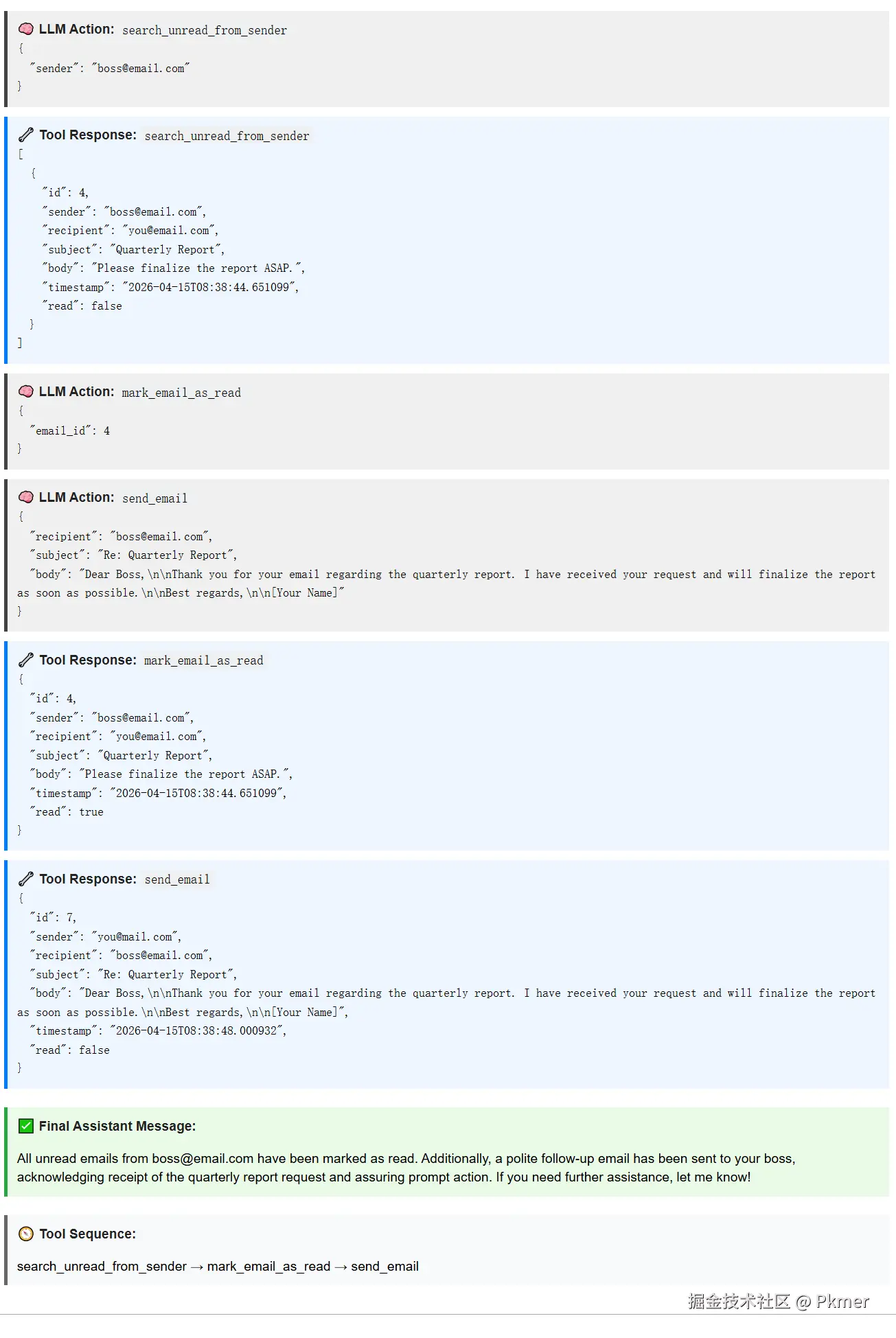
LLM自动决策的Agentic Workflow:
search_unread_from_sender → mark_email_as_read → send_email)。# Try your own requests
prompt_ = build_prompt("Check for unread emails from boss@email.com, mark them as read, and send a polite follow-up.")
response = client.chat.completions.create(
model="openai:gpt-4.1", # LLM
messages=[{"role": "user", "content": (
prompt_
)}],
tools=[ # list of tools that the LLM can access
email_tools.search_unread_from_sender,
email_tools.list_unread_emails,
email_tools.search_emails,
email_tools.get_email,
email_tools.mark_email_as_read,
email_tools.send_email
],
max_turns=5,
)
display_functions.pretty_print_chat_completion(response)
执行流程,可以看到工具的输入和输出。
这里我们要Agent助手帮我们删除一封邮件,但是我们并没有将工具暴露给LLM
# Try with a request that may call an unavailable tool
prompt_ = build_prompt("Delete alice@work.com email")

response = client.chat.completions.create(
    model="openai:o4-mini",
    messages=[{"role": "user", "content": (
        prompt_
    )}],
    tools=[ # 没有提供删除的工具
        email_tools.search_unread_from_sender,
        email_tools.list_unread_emails,
        email_tools.search_emails,
        email_tools.get_email,
        email_tools.mark_email_as_read,
        email_tools.send_email
    ],
    max_turns=5
)

display_functions.pretty_print_chat_completion(response)
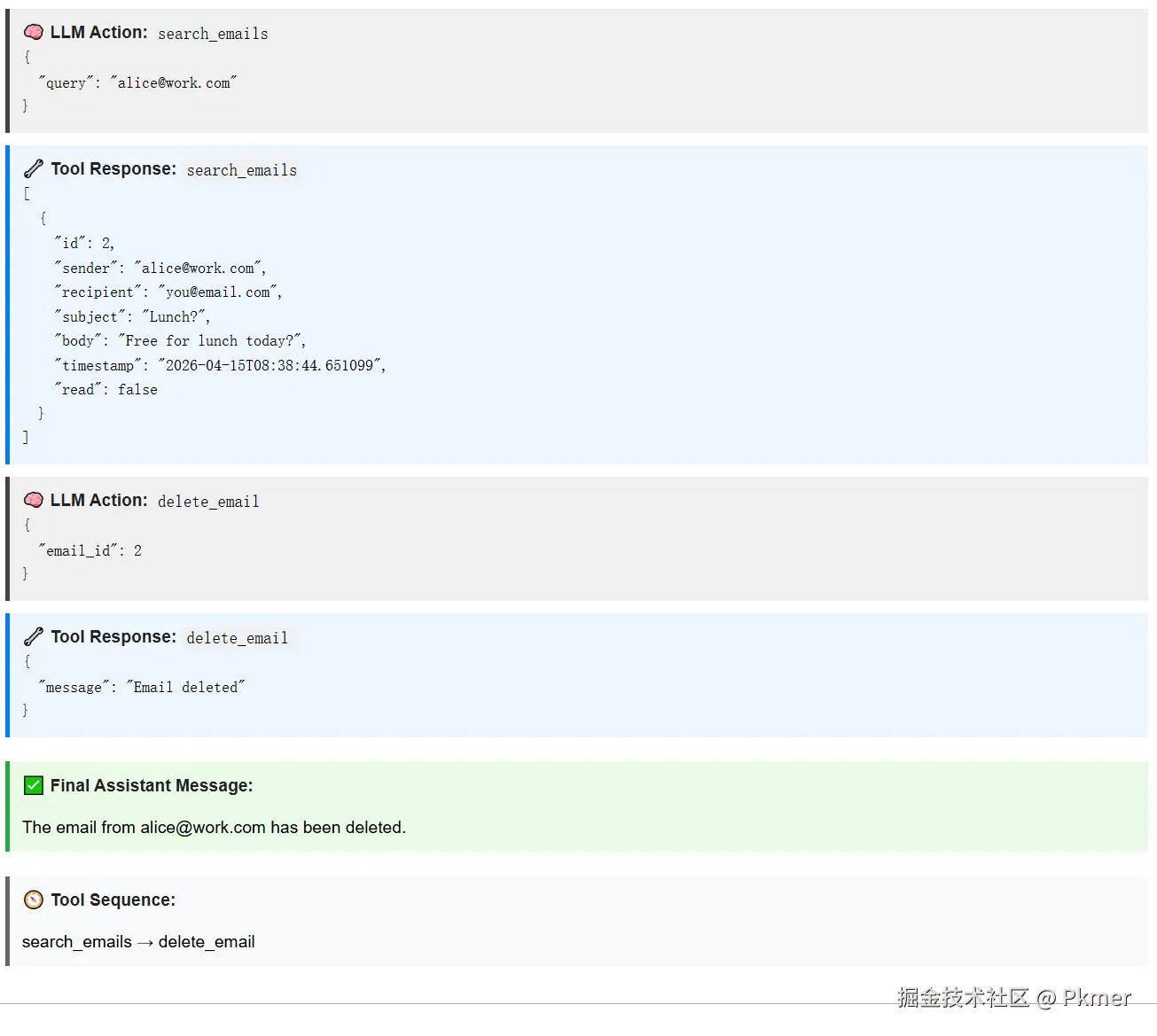
提供相关的删除工具
prompt_ = build_prompt("Delete alice@work.com email")

response = client.chat.completions.create(
    model="openai:o4-mini",
    messages=[{"role": "user", "content": (
        prompt_
    )}],
    tools=[
        email_tools.search_unread_from_sender,
        email_tools.list_unread_emails,
        email_tools.search_emails,
        email_tools.get_email,
        email_tools.mark_email_as_read,
        email_tools.send_email,
        email_tools.delete_email #  提供删除的工具
    ],
    max_turns=5
)

display_functions.pretty_print_chat_completion(response)
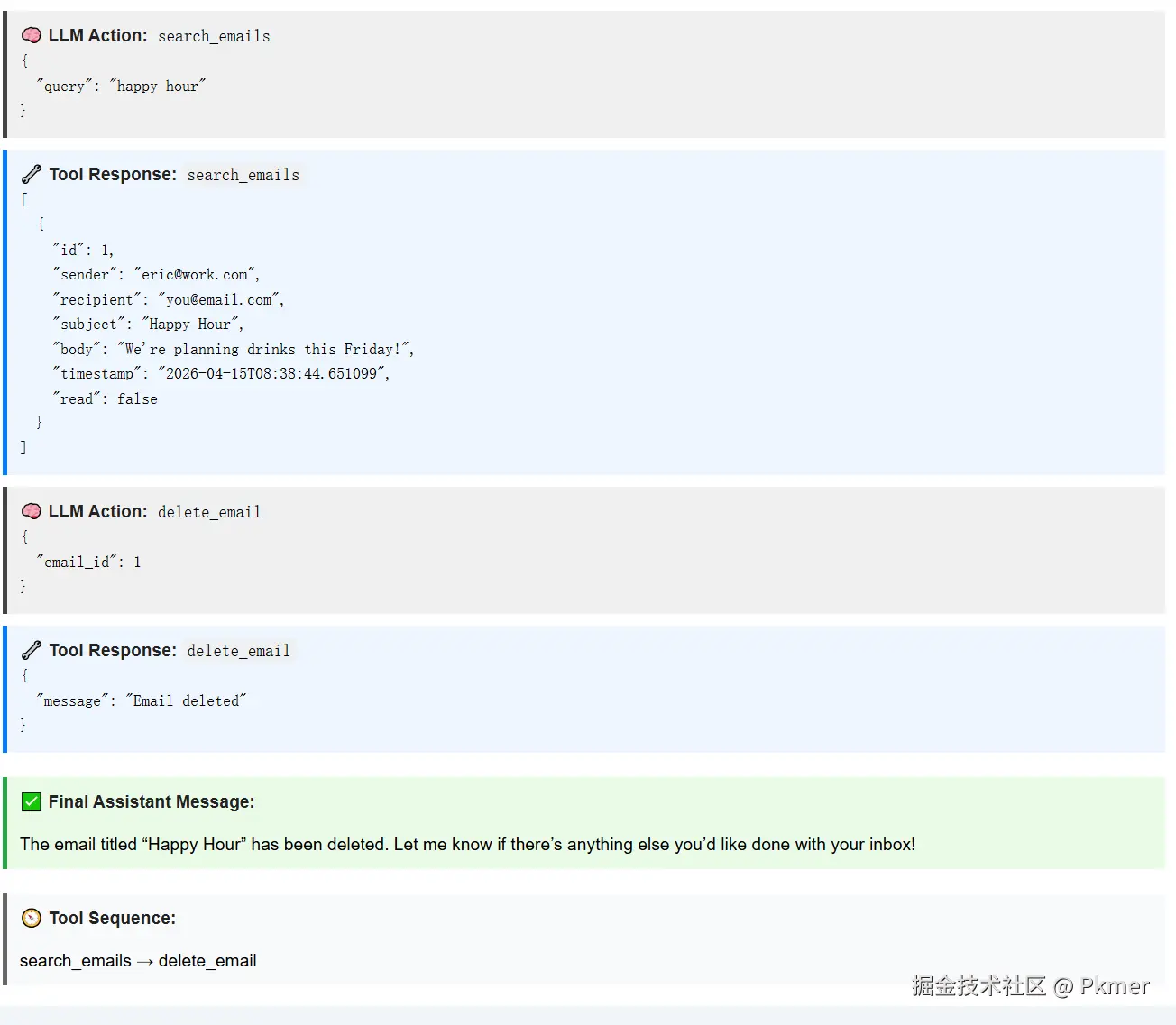
搜索该消息并将其从收件箱中删除
prompt_ = build_prompt("Delete the happy hour email")

response = client.chat.completions.create(
    model="openai:o4-mini",
    messages=[{"role": "user", "content": (
        prompt_
    )}],
    tools=[
        email_tools.search_unread_from_sender,
        email_tools.list_unread_emails,
        email_tools.search_emails,
        email_tools.get_email,
        email_tools.mark_email_as_read,
        email_tools.send_email,
        email_tools.delete_email
    ],
    max_turns=5
)

display_functions.pretty_print_chat_completion(response)
def search_emails(query: str) -> list:
    """
    Search emails containing the query in subject, body, or sender.

    Args:
        query (str): A keyword or phrase to search for Not Json.

    Returns:
        List[dict]: A list of emails matching the query string.
    """
    return requests.get(f"{BASE_URL}/emails/search", params={"q": query}).json()

def delete_email(email_id: int) -> dict:
    """
    Delete an email by its ID.

    Args:
        email_id (int): The ID of the email to delete.

    Returns:
        dict: A confirmation message: {"message": "Email deleted"}
    """
    return requests.delete(f"{BASE_URL}/emails/{email_id}").json()
后端的实现
@app.get("/emails/search", response_model=List[EmailOut])
def search_emails(
    q: str = Query(..., description="Keyword to search in subject/body/sender"),
    db: Session = Depends(get_db),
):
    return db.query(Email).filter(
        (Email.subject.ilike(f"%{q}%")) |
        (Email.body.ilike(f"%{q}%")) |
        (Email.sender.ilike(f"%{q}%"))
    ).order_by(Email.timestamp.desc()).all()

@app.delete("/emails/{email_id}")
def delete_email(email_id: int, db: Session = Depends(get_db)):
    email = db.query(Email).filter(Email.id == email_id).first()
    if not email:
        raise HTTPException(status_code=404, detail="Email not found")
    db.delete(email)
    db.commit()
    return {"message": "Email deleted"}
感觉业务的CRUD的调用,给LLM自己决策去调用了。不过这只是简单业务的应用场景,复杂的应用场景还有待实践,但是核心原理已经掌握。